Jordi Alemany: “The balance between well-being and economy is the ultimate paradigm”
María Fernanda Castillo, one of the founders of Nala, spoke with the Spaniard Jordi Alemany, a senior business consultant who has specialized in leadership innovation, cultural transformation, and talent development and who is currently an influencer in “Business Humanizers” and imperfect leadership. In the interview, he talked about how management should be…
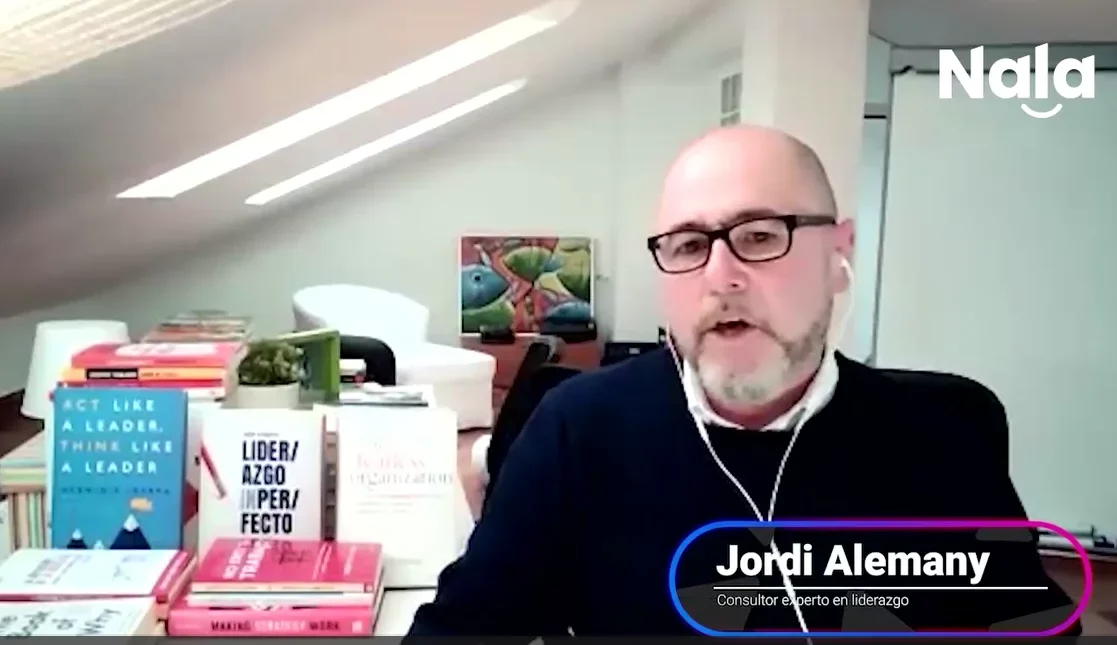
María Fernanda Castillo, one of the founders of Nala, spoke with the Spaniard Jordi Alemany, a senior business consultant who has specialized in leadership innovation, cultural transformation, and talent development and who is currently an influencer in “Business Humanizers” and imperfect leadership.
In the interview, he talked about how companies should manage their collaborators, about leadership, and his vision of the future of work.
At the beginning, the Spaniard talked about his work life, about a crucial moment in it: when he asked his mentor, Michael Archer, for advice, which, according to Jordi Alemany, “raised him 3 levels at once in the field of leadership.”
Next, part of this interview:
- What were those three things that changed and made you a better leader?
He taught me (his mentor) that being vulnerable makes you closer and more likable to people, that is, showing your weaknesses is not a weakness but a strength.
Secondly, that when you become a leader your role stops being to score higher than the rest of the team, to be the best on the team; your role starts to be to make your team the best. That is something we are not taught either, we are taught to compete and many times we are promoted based on our individual performance and therefore we reach the position of manager as a reward for what we have done personally, which generates a mental pattern in our head that is ‘I have to keep proving that I am the best and if now the task assigned to me was to lead others I have to be the best manager.’ But in that confusion of not knowing very well what it means to be the best manager, we think that being the best manager is being the best on the team and not making our team better.
Thirdly, I learned that when you listen before responding you become much wiser. I was a person who talked much more than I listened and who listened poorly, I listened to respond, with my mind programmed to say what I wanted to say and argue what I wanted to argue, defend my argument and have a soldier mentality and not an explorer mentality.
The difference between the soldier mentality and the explorer mentality is that a person with a soldier mentality listens to defend their position and considers any opinion that differs from theirs as the enemy, it must be destroyed. A person with an explorer mentality listens to learn why the other person thinks differently, where that person comes from, in what universe they have lived, what education they have received, what experiences and life events they have had. When you listen to learn and to explore other universes you become a much better person and make the other person feel much better.
Those three pillars were what made me jump three levels up and suddenly see how my teams that had fun working, but also suffered with me, went not only to having fun and learning, but also to admiring me and wanting to be close to me and that leads you to levels of commitment and performance far above average.
- You were in this leadership position with all your virtues and not-so-virtues, why start talking about imperfect leadership?
Precisely because of this experience, because I said if I was able to become a good leader having been so clumsy and having done so many things wrong and this experience changed my life, helped me transform my mentality and understand leadership differently and be much more human, closer, more humble and more generous in general, less competitive. This was thanks to the figure of a mentor, a generous, kind person who wanted to share all his experience and his worldview, not only about the company, with me. So, I can do the same with other leaders and if I achieve that I will see the same results I saw with my team.
A leader can be anyone, anyone with attitude and good support can become a good leader and the best example of that is me, who was a workaholic, who was a bad boss, who is very clumsy in many things, but I keep learning and whenever someone has the kindness to help me and I have the attitude to want to learn, I will be a better person and make those around me better.
- How should companies manage today understanding that they don’t want to “burn out” talent?
Undoubtedly the world is better than 250 years ago when the first industrial revolution took place, but that is no reason not to keep improving. What happens is that the points of improvement are changing and at this moment the improvement is more about recovering the person, returning to the human, and transforming models, especially the capitalist model - which for me is the only viable model - but it needs certain adjustments and reviews.
The capitalist model focused on short-term results and on general zombie workaholics who end up sick and suffering in other areas of their lives, is not good for society because it consumes resources and generates a very high cost, an emotional toll and also an economic toll, because, for example, countries with public health systems have to invest a lot of millions of euros, pesos, dollars a year in curing, in alleviating physical and mental health problems that occur in any environment and the work environment is where we spend 1/3 of our time.
I am against savage capitalism, capitalism in which four shareholders concentrate 15% of the wealth of a country or the planet. I am in favor of more conscious capitalism, of 5 stakeholders in which employees, suppliers, clients, shareholders, and civil society and the planet, who are those who intervene and interact with the business organization daily and add value, must also have enrichment both economically, so the economy works, and emotionally. They must have a reward, recognition for their contribution in general, produce well-being. The balance between well-being and economy is the ultimate paradigm, it is the Nirvana of political management of leadership and that is the kind of leadership we should aspire to.
A company made up of sick employees is a sick company, and a sick company is one that does not generate the results it could produce but also generates an additional cost that we all end up paying.
- What should be the balance companies seek between being very proactive in a chaotic environment like today, where unexpected things happen and they need to be prepared for everything at all times, and caring about people’s mental health?
The balance should consist of the fact that the organization’s resources are economic and material and people should not be part of the resource equation for one reason: because resources are replaceable, substitutable, rotatable. And the people who have been incorporated, we put them there, and therefore assume they carry the same labels on their backs; replaceable, rotatable, exploitable and that is not how human beings work.
Human beings operate with a central unit which is a brain that basically produces emotions which somehow define our attitude, our behavior, our decision-making process. When those emotions are toxic and negative and filtered in gray or black the decision-making is contaminated because it is an intrinsic and interconnected process. So if I feel bad, the decisions I make will surely be bad and what does a worker, what does a leader do in a business organization? They are making decisions all the time.
So if we are not aware that human resources are not a material or physical or economic resource, but that we are a resource that has a CPU that makes decisions by itself based on its emotions, we will not be able to optimize the productivity of organizations.
First step: we must separate the human from the rest of the organization’s resources. The human has other components and therefore requires other metrics, other evaluation processes and other management and influence processes, and in that sense we have to manage resources and lead people. What does leading people mean? It means making those people feel better, have an easier life, feel that their contribution to the organization results in a benefit for themselves, not only salary, (...) we must look for other motivating elements that are found in the family, spiritual, social, health, well-being plane.
- How do you imagine the future of work? How do you imagine this will continue changing in the next 5, 10 years?
We are going to a world where intelligence will replace what until today have been human intelligences, linguistic and mathematical, which are the ones taught throughout the educational cycle and there we have to make a whole transformation of the educational model because otherwise, we will go to ruin.
Secondly, we have to rethink what we are going to do with all those people who will be left disengaged from the labor world, we will see unemployment grow a lot with these new intelligences and we will go through a painful period until we reach a third stage of the transformative cycle, in which we will have to rethink not only what we do with the people who have been left engaged, but what humans do in work, social environments, etc. and I believe that human goals have to be raised and we will see professions such as, for example, ethical negotiators.
We will also have to aim to develop other intelligences such as kinesthetic, creative, spatial, social or interpersonal and intrapersonal. We will go to a much more humanistic model, because technology will replace everything humans do in robot mode and that is where companies have to rethink those human resources because human resources will be automatic resources, technological resources, digital resources, robotic resources so people will be left out of that equation. But notice that we are the people who consume, who have emotions and make decisions, and with those decisions we can make a company go bankrupt or make a company much bigger and end up leading its sector.
You cannot take the human out of the equation, you have to start considering the human not as a replaceable link, but as a fundamental piece of the socioeconomic model.
You can watch this conversation at the following link: