Webinar "Nala Leadership Matrix: Know, retain and manage the leaders of your organization"
People from different parts of the world participated in Nala's leadership webinar held last April 27. María Fernanda Castillo, cofounder of Nala, explained how the Nala Leadership Matrix works and its importance for companies to identify their leaders. María Fernanda Castillo, cofounder of Nala, has more than 15 years of…
People from different parts of the world participated in Nala's leadership webinar held last April 27. María Fernanda Castillo, cofounder of Nala, explained how the Nala Leadership Matrix works and its importance for companies to identify their leaders.
María Fernanda Castillo, cofounder of Nala, has more than 15 years of experience in human resources for global companies and one of the challenges she identified in human capital is the identification and management of leaders within organizations. “For us, it is a priority to give companies visibility on how these leaders are leading,” she states.
Are people working at 100%, at 200%? Do we really have the right people in the right place, contributing all their maximum value? Do we have well communicated where we are going, where we want to go, and are we pushing in the same direction? These are the questions asked by general management regarding their three objectives to remain agile: Productivity, efficiency, and alignment.
“If we from human capital help ensure that the objectives are met, they will have that mental peace, and the only way I can meet those three objectives is through my leaders,” María Fernanda points out.
“If my leaders are aligned, are seeking for the company to be productive, that we hire the right people, that we put them in the right place, that they are focused, that they know where we are going and that they are working, our job is easier,” the cofounder maintains.
So, the goal is for leaders to have that mindset and work to build a culture that attracts and retains talent and makes companies 100% productive.
Leaders are necessary
The expert in talent and performance management highlights a 2002 Google study in which the tech giant decided to eliminate managerial positions to have a 100% flat organization, work by cells, and make everything more dynamic. “Very quickly, they had to reverse this decision and what they realized is that leaders are necessary, not bosses, but leaders are very necessary,” María Fernanda recounts.
“There are people who must take responsibility for the teams they lead, from very basic things like who do I ask for vacation, who will worry about my next raise, to things like who is that person I can ask for direction, guidance, when I am stuck with a problem,” she adds.
From this study, the cofounder confirmed that the leader does impact productivity. “There is a set of skills that consistently repeat in these leaders who can get the best performance from their people and through them I can achieve and generate a culture that attracts and retains talent, and this makes the company enter this virtuous circle and from that moment, giving visibility on how leaders lead becomes a priority for Nala,” she affirms.
Classic leadership model
Until today, this is how a leadership model looks, where the steps to follow are:
- A competency model for leaders is defined
- They are measured during performance evaluation
- The performance result + potential places them in the 9Box
- Result visibility of top talent
- A Leadership school is created where all leaders are trained transversally
This whole procedure takes time and effort for companies. From Nala, there is the possibility to make a 9Box matrix in a fast and agile format, “however, I saw three challenges that this did not help me solve to be able to see these leaders,” indicates the expert in talent and performance management at Nala.
Visibility, focus, and resources: Challenges to identify leadership
“I have the 9Box, but is it possible to create a tool that allows us to map and see the top leaders? Because top talent is very different from top leader,” María Fernanda questions.
And she explains that “in one I am measuring focus 100% on that person's performance, on their potential, but I am not measuring their management, so I can have people in the 9Box but I don't know if their management is really doing the best and impacting business indicators.”
The second problem is focus, where the question was whether it is feasible to identify the initiatives each leader must prioritize.
Regarding resources, with the current leadership model expenses are high, and the question was whether it is possible to measure the impact of these initiatives on business indicators.
Nala Leadership Matrix
The matrix comes to answer these three challenges.
Visibility
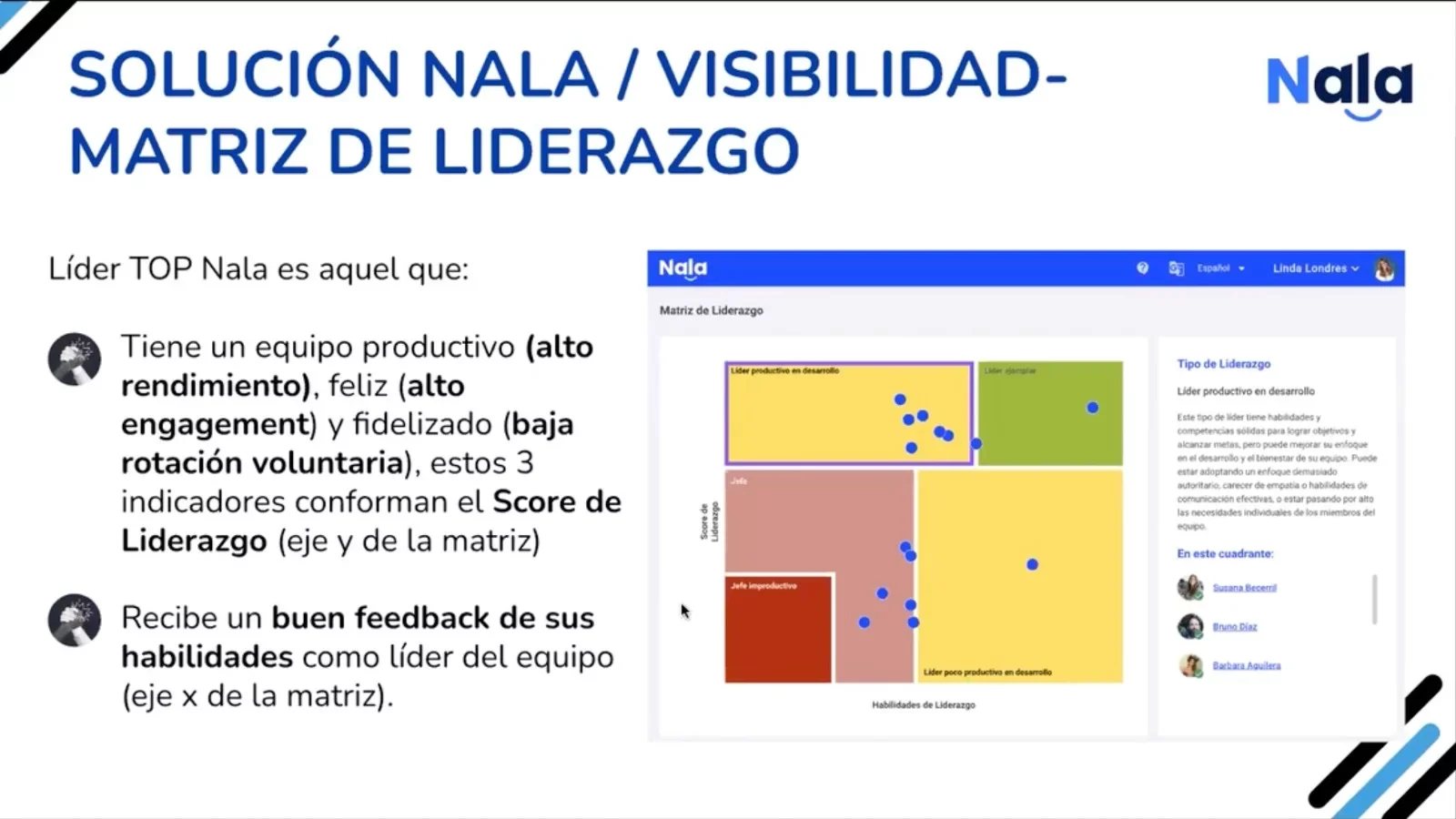
To solve the visibility problem, Nala opted for a 9Box matrix that visually helps prioritize decision-making and places people in certain quadrants to trigger alerts.
This matrix combines two axes, the first is “leadership score” where the productivity of that leader is measured. “If I have a leader who has a highly productive team, that is, a team with good performance, whose team is also happy, has high engagement and is loyal, not voluntarily rotating, that is a productive leader, a leader who has a high “leadership score,” María Fernanda explains.
On the other hand, there are “leadership skills,” where feedback received about that leader's skills with their team is collected. “If their team values that leader as having those skills more developed, very good comments, the leader will be placed more on the right axis,” she exemplifies.
Focus
The matrix has a table that explains each of those indicators we are measuring so that companies quickly know how to solve the individual problem of each leader.
For each leader, both those who are doing very well and those who are doing very poorly, the matrix provides specific actions that can be taken and that help see the impact it will have.
Resources
Nala not only gives this quick view of where the leaders are but also provides the leader with their assessment of the measured skills.
“If you have a problem in leadership skills, this report is received by the leader where it will show each of those skills measured, what question was asked, how it was seen, and if there is something they want to improve, Nala recommends resources such as readings, videos, so that the leader can work on those skills autonomously, they don't need someone else to come and do it,” the cofounder points out.
At the same time, the human capital area is given a complete diagnosis of the company so that if it decides to invest in leadership, in training, it does so not with all leaders, but with the percentage that requires it.
“If we focus only on these leaders who are much fewer, the results we will have are better and that is the idea, that we know where to invest resources and can see if this over time really impacted those business indicators we are seeing here,” she adds.
Agility: Nala's mantra
The “backbone” of Nala is agility, so achieving that this process had this characteristic was vital.
On one hand, the “leadership score” is something companies do not have to enter, but Nala automatically collects it from the platform which updates every three months and thus the matrix every three months will generate a new history of the person, to be able to see the evolution of the leaders.
Meanwhile, the “leadership skills” is an extremely short pulse, which takes collaborators only a few minutes and it is enough to do it twice a year. “All so that the leader can know what they have to work on, what they must improve and that you have this matrix updated,” María Fernanda concludes.
Watch the full webinar here: